Call for Papers
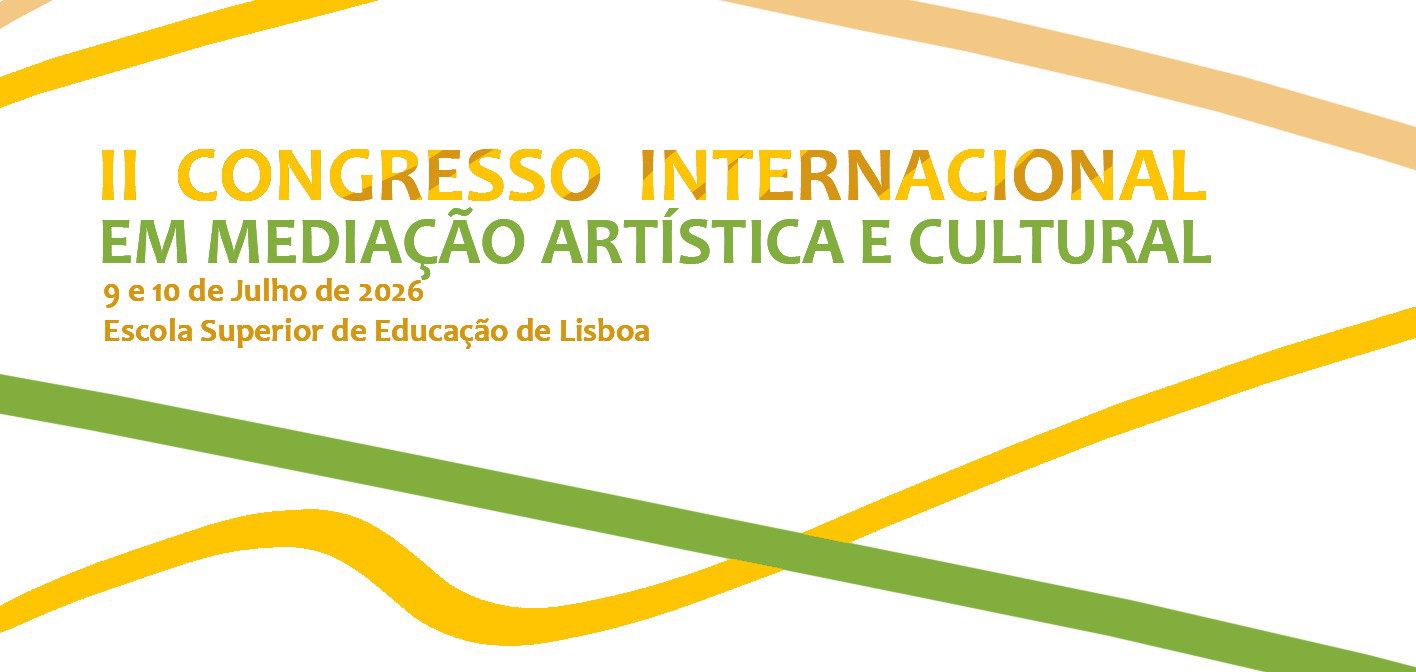
Artistic and Cultural Mediation: What Transformations?
In 2022, the first International Congress on Artistic and Cultural Mediation was held at the Lisbon School of Education. Building on that first edition, this second congress seeks to deepen the reflection on the role, evolution, and impact of artistic and cultural mediation in contemporary societies. Faced with significant changes in the place of artists and the arts, as well as in the relationships between audiences and artistic expressions, a new professional field has gradually emerged: artistic and cultural mediation. These developments have made it increasingly important to question how mediators construct their professional identity and how their work contributes to social, cultural, and institutional transformation. In recent years, the gradual development of artistic and cultural mediation in Portugal (Cruz, Suzanne & Vohlgemuth, 2025) has visibly accelerated. This can be observed in the growing number of short-term training courses (such as those promoted by the National Arts Plan and Acesso Cultura) and in the implementation of Cultural Projects in Schools across most school clusters under the National Arts Plan, supported by the Ministries of Education and Culture. Although artistic and cultural mediation is not yet formally recognized as a profession—whether in Portugal or in France (Aboudrar & Mairesse, 2025)—professionals performing mediation tasks are increasingly present in cultural organizations, and expectations regarding their contribution continue to rise. This congress aims to bring together researchers, professionals, and students to analyze the transformations generated by mediation practices, as well as the conditions that make such practices possible—whether through policies, institutional frameworks, or professional and artistic approaches. These transformations may occur at structural levels (such as policy development and regulatory frameworks) or as outcomes of mediation activities, and they may affect individuals, cultural organizations, territories, and/or broader cultural practices (Arnaud, 2018; Mörsch & Fürstenberg, 2012; Pires do Vale & Brighenti, 2023; Suzanne, 2022). We welcome contributions grounded in research or professional practice, including critical analyses of projects already implemented and investigations into frameworks shaping cultural action at different territorial scales. Proposals should align with one of the following thematic axes:
Axis 1: Artistic and Cultural Mediation – Policies and Transformations
From André Malraux’s early cultural policies for democratizing culture in France (Caune, 1996) to sociological studies exploring the connections between social classes and cultural practices (Bourdieu, 1966, 1977, 1979; Donnat, 1994; Lahire, 2006, 2012; Neves, 2001; Pais et al., 2022), cultural democracy has gradually been integrated into legal and normative frameworks (Cruz et al., 2025). This evolution also reflects the politicization of culture—the process through which cultural practices and issues become political objects with broader societal implications (Dubois, 2012).Artistic and cultural mediation has emerged within this interplay between political authorities, cultural institutions, artists, and audiences. We invite proposals that explore how cultural policies enable or shape mediation practices, as well as analyses of how mediation initiatives can influence or generate new cultural policies at local, regional, or national levels.
Axis 2: Artistic and Cultural Mediation – Territories and Transformations
Cultural action—and mediation in particular—faces artistic, social, political, and economic challenges that shape cultural boundaries (Arnaud, 2018). Territories, understood as geographic, social, and symbolic spaces ranging from the local to the global, frequently mobilize mediation projects to support community development, participation, and social inclusion (Costa, 2018).Such projects may lead to the reappropriation of public spaces by residents (Hassani, 2019), fostering renewed connections between communities and cultural practices. We welcome proposals from Portugal and abroad that analyze how mediation contributes to territorial transformation, as well as studies on how territorial characteristics influence the design, implementation, or sustainability of mediation projects.
Axis 3: Artistic and Cultural Mediation – Cultural Organizations and Transformations
In Portugal, following the Porto Santo Charter (2021)—which emphasizes the complementarity of cultural democratization and cultural democracy in strengthening democratic life—the Social Impact Commitment Kit for Cultural Organizations was launched in 2023 (Pires do Vale & Brighenti, 2023). This document provides principles and tools for evaluating and monitoring social impact within cultural institutions.Similarly, in Switzerland, Mörsch and Fürstenberg (2012) highlight how mediation practices can drive organizational change and reshape institutional roles and responsibilities. We seek proposals that examine cultural organizations either as agents of transformation or as entities transformed through mediation interventions, including those implemented in educational contexts.
Axis 4: Artistic and Cultural Mediation – Practices and Transformations
At the individual level, mediation activities can generate significant transformations for participants, artists, and professionals involved. As Maurel (2010) and Henry (2014) argue, the aim is not merely to cultivate more engaged spectators but to promote personal development and expanded cultural participation.New ways of understanding art encourage us to conceive the artistic space as a site of reciprocal transformation between creators and audiences (Rathier & Innocenti, 2010). With the expansion of the National Arts Plan, it is increasingly important to study the impact of mediation within schools—on students, teachers, and educational practices—as documented in various studies (Kerlan et al., 2015).
References
Aboudrar, B., & Mairesse, F. (2025). La médiation culturelle (4o ed). Paris: Presses Universitaires de France.
Arnaud, L. (2018). Agir par la culture. Toulouse: Editions de l’Attribut.
Bourdieu, P. (1977). Sur le pouvoir symbolique. Annales. Histoire, Sciences Sociales, 32(3), 405–411. https://doi.org/10.3406/ahess.1977.293828
Bourdieu, P. (1979). La distinction. Critique sociale du jugement. Paris: Minuit.
Bourdieu, P., & Darbel, A. (1966). L’amour de l’art. Les musées d’art européens et leur public. Paris: Minuit.
Caune, J. (1996). La politique culturelle initiée par Malraux . Espaces temps.net.
Conferência do Porto Santo; Républica Portuguesa – Cultura; Plano Nacional das Artes; GEPAC; (2021). Carta do Porto Santo: A cultura e a promoção da democracia: para uma cidadania cultural europeia. (2021). Região Autónoma da Madeira; Madeira Islands; 2021Portugal.EU: Região Autónoma da Madeira; Madeira Islands;Portugal.EU.
Costa, P. (2018). Estratégias para a cultura da cidade de Lisboa 2017. Lisboa. Recuperado de http://www.cm-lisboa.pt/fileadmin/VIVER/Cultura_Lazer/ESTRA_CULTURA_LISBOA_2017_01.pdf
Cruz, C., Suzanne, G., & Vohlgemuth, L. (2025). Olhares cruzados sobre a emergência da mediação artística e cultural nas políticas culturais em Portugal. Rotura – Revista De Comunicação, Cultura E Artes, 5(2), 227–243.
Donnat, O. (1994). Les Français face à la culture, de l’exclusion à l’éclectisme. Paris: La Découverte.
Dubois, V. (2012). Le Politique, l’artiste et le gestionnaire: (Re)Configurations locales et (dé)politisation de la culture. Vulaines sur Seine: Éditions du Croquant.
Hassani, C. (2019). Impulsion artistique pour la transformation en Europe, au Moyen-Orient et en Afrique du Nord. In W. Schneider, Y. Butel, T. Bärworlff, & G. Suzanne (Orgs.), Dispositif de transformation Pratiques culturelles et processus artistiques (p. 21–34). Universitätsverlag Hildesheim.
Henry, P. (2014). Un nouveau référentiel pour la culture? Toulouse: Editions de l’Attribut.
Kerlan, A., Carraud, F., Choquet, C., & Langan, S. (2015). Un collège saisi par les arts. Toulouse: Editions de l’Attribur.
Lahire, B. (2006). La culture des individus (2a). Paris: La Découverte.
Lahire, B. (2012). Tableaux de famille (3o ed). Paris: Gallimard.
Maurel, C. (2010). Le travail de la culture: des concepts aux pratiques. In F. Liot (Org.), Projets culturels et participation citoyenne. Paris: L’Harmattan.
Mörsch, C., & Fürstenberg, S. (2012). Le Temps de la Médiation. Recuperado de https://www.kultur-vermittlung.ch/zeit-fuer-vermittlung/v1/?m=10&m2=8&lang=f
Neves, J. S. (2001). Práticas culturais dos portugueses (2): Espetáculos ao vivo. Folha OBS, 3.
Pais, J. M., Magalhães, P., & Antunes, M. L. (2022). Inquérito às Práticas Culturais dos Portugueses 2020 Síntese dos Resultados. Lisboa. Recuperado de https://www.ics.ulisboa.pt/sites/ics.ulisboa.pt/files/2022/inquerito_praticas_culturais_2020.pdf
Pires do Vale, P., & Brighenti, S. (2023). Compromisso de Impacto Social das Organizações Culturais Fundamentos, Metodologia e Instrumentos de Apoio. Recuperado 3 de novembro de 2025, de https://cisoc.pna.gov.pt/kit-cisoc/
Rathier, J.-P., & Innocenti, L. (2010). Qu’est-ce qu’une action culturelle appropriée? In F. Liot (Org.), Projets culturels et participation citoyenne (p. 99–114). Paris: L’Harmattan.
Suzanne, G. (2022). Esthétique de la médiation. Aix-en-Provence: Presses Universitaires de Provence.